Q4 budget review season is here. Across Boise and the wider Treasure Valley, homeowners are reviewing every recurring household cost before winter sets in. Insurance, HOA dues, service contracts, home warranties. Most people assume their home warranty is a safety net for appliances. What the fine print actually says is a different story.
Idaho is in the middle of a historic drought cycle heading into 2026-27. According to East Idaho News reporting from September 2026, reduced snowpack and reservoir drawdown are concentrating minerals in groundwater across the Snake River Plain aquifer system. Less water volume moving through the system means less dilution of naturally occurring calcium and magnesium. The result: water hardness in parts of the Treasure Valley is already at 18-22 grains per gallon (GPG), and well-water homeowners in outlying areas are trending higher.
At 20 GPG, your water heater, dishwasher, and washing machine are fighting mineral scale every single day. And when they finally fail, most home warranty providers will deny the claim. Here is why, and what you can do before winter hits.
What Most Home Warranties Actually Cover
Home warranties are designed to cover mechanical and electrical failures that result from normal wear and tear. The operative phrase in nearly every contract is "mechanical failure." A compressor that seizes up, a heating element that burns out from ordinary use, a pump that simply wears down over years of operation -- these are the scenarios warranties are written for.
What they are not designed for: water quality issues. This distinction is buried in the "Limitations and Exclusions" section that most homeowners never read at signing. Major providers including American Home Shield, Choice Home Warranty, and 2-10 Home Buyers Warranty all carry explicit exclusion language for mineral deposits, scale buildup, and hard water damage. It is not a technicality or an edge case. It is standard across the industry.
If you have a home warranty, pull out your contract right now and look for the words "mineral," "scale," or "water quality." What you find will matter this winter.
Why Hard Water Damage Is Almost Always Excluded
Warranty providers categorize hard water damage as a water quality issue, not a mechanical failure. From their perspective, the root cause is the water entering the home, not the appliance itself. Because the homeowner controls whether softening or filtration is installed, the damage is considered preventable and therefore excludable.
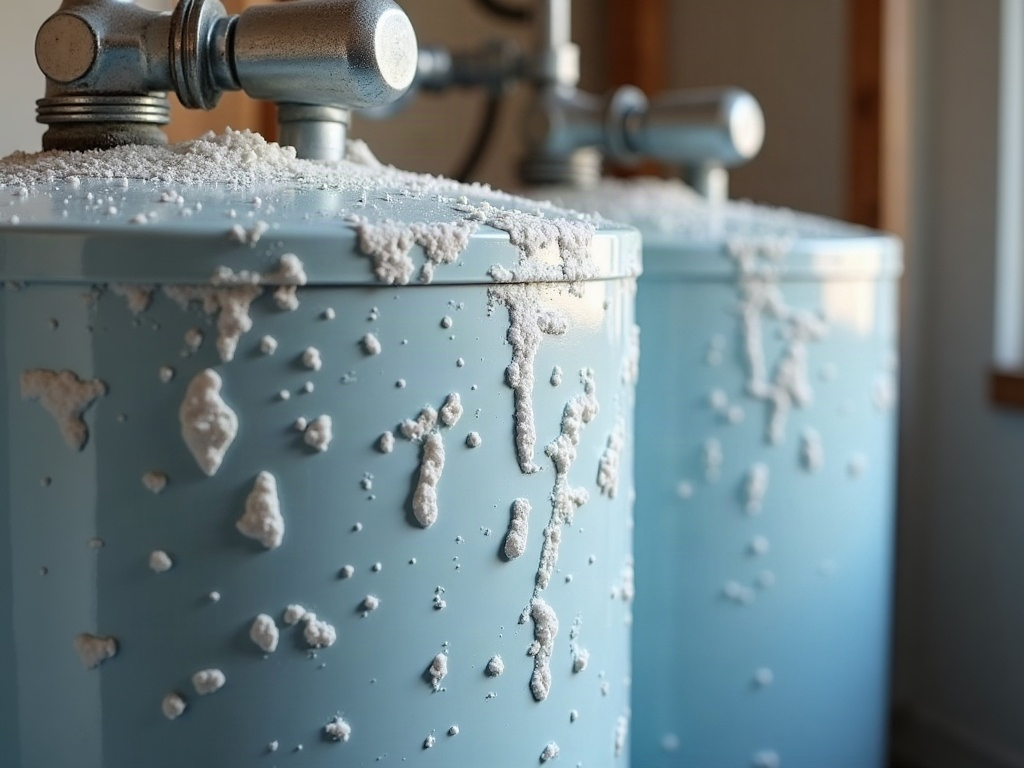
Here is the mechanical reality. At 20 GPG, water deposits roughly 1.5 pounds of calcium carbonate per month inside a standard water heater tank. That mineral layer accumulates between the heating element and the water. It forces the unit to run hotter and longer to reach the same temperature. Energy bills climb. The element itself works harder than it was designed to. Eventually, it fails.
The same dynamic plays out in every water-using appliance. Dishwasher spray arm nozzles clog and etch. Washing machine heating elements and pump seals accumulate scale deposits. Ice maker lines narrow and restrict flow. In each case, the warranty exclusion language applies because the damage pathway runs through water quality, not through normal mechanical wear.
Typical exclusion language reads: "This contract does not cover failures caused by hard water, mineral deposits, scale accumulation, or improper water quality." Some contracts go further, voiding coverage for the entire appliance if scale damage is found during inspection, even if the immediate failure had an unrelated cause.
The Real Cost in Boise Homes
When the claim is denied, the full replacement cost lands on the homeowner. In Boise, current replacement cost ranges run approximately:
- Water heater: $900 to $1,400 installed
- Dishwasher: $700 to $1,100 installed
- Washing machine: $600 to $900
These costs are not hypothetical. They are the average repair and replacement figures for Treasure Valley homes, and they tend to arrive at the worst possible time. For a deeper breakdown of how scale buildup destroys appliances and what the timeline looks like, see our full guide on hard water appliance damage costs in Boise.
Winter accelerates the problem. Cold incoming water causes faster scale precipitation when the water heater cycles on. Usage patterns spike during winter months. Appliances that were marginal in September often fail in January, right when budgets are tightest and replacement costs peak with demand.
The Drought Connection -- Why 2026-27 Matters
Idaho's historic drought heading into 2026-27 is not just a farming story. It has a direct water quality angle for homeowners.
Boise's municipal supply draws from deep aquifers that are largely buffered from short-term surface conditions. Short-term, municipal customers are shielded. But geologists are consistent: prolonged drought cycles do eventually affect deep aquifer recharge rates, and the buffering effect diminishes over multi-year cycles.
For homeowners on well water or surface water systems across the Treasure Valley, the impact is more immediate. As reservoir levels drop and less water moves through the Snake River Plain aquifer system, the same minerals that have always been present become more concentrated. If you are on a private well and have not tested your water in the past 12 months, now is the right time. Increased hardness this season is not a theoretical risk.
What Proactive Homeowners Do Instead
The warranty exclusion is not the real problem. The real problem is paying $900 to $1,400 for a preventable appliance failure. The math on prevention is straightforward.
A salt-based water softener removes calcium and magnesium ions before the water reaches your appliances. No ions in the water, no scale forming on heating elements, no mineral buildup clogging spray nozzles. The softener is solving the root cause, not treating the symptom.
Most Boise-area homeowners see a properly sized water softener pay for itself within 2 to 3 years through avoided appliance repairs, lower energy bills (scale-coated water heaters use 15-30% more energy), and extended appliance lifespans. Prevention costs zero dollars per month once the system is installed and maintained. Replacement costs $900 to $1,400 per event.
Before buying equipment, the smart move is knowing your exact hardness level. Treasure Valley readings range from 15 to 25 GPG depending on your specific location and water source. Get a free water test from TrueWater Idaho first, so you know what you are actually dealing with before choosing a system.
Frequently Asked Questions
Does my home warranty cover hard water damage to appliances?
How does hard water actually damage appliances over time?
What is the most effective way to prevent hard water appliance damage?
Is Boise's water getting harder because of the drought?
Know Your Water Before Winter
Free water hardness test for Treasure Valley homeowners. Know exactly what your appliances are up against.